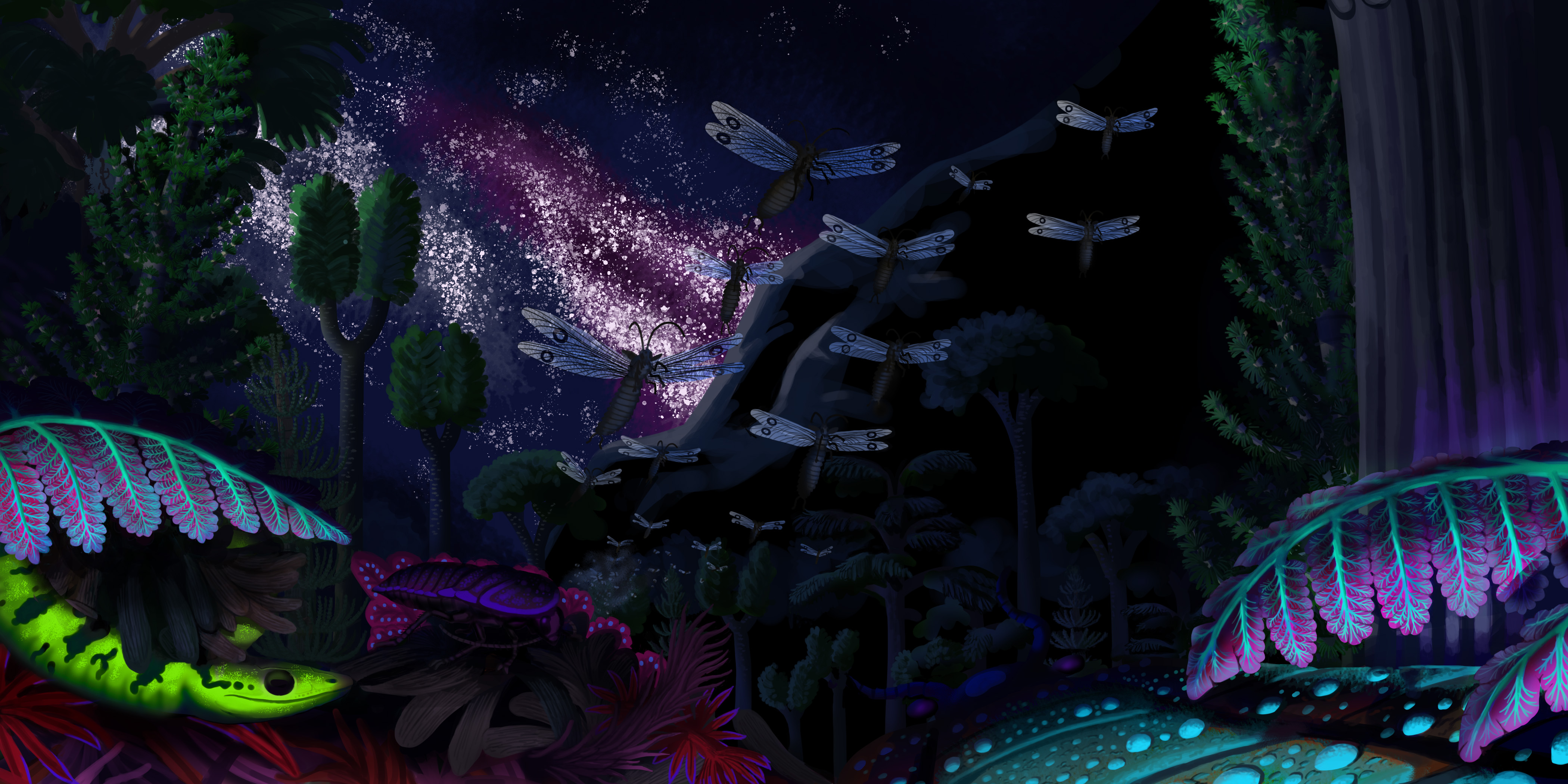
Just like modern animals, it is likely that Paleozoic plants and animals were often capable of fluorescing under UV light as well. To my completely-untrained eye, it looks like a lot of amphibians glow green, and millipedes often go blue? And I feel like I see a lot of reddish ferns as well. Phlegethontia is an aistopod - an amphibian-like tetrapod that was amongst the first to lose its legs, as an aistopod. Platymylacris is a cockroach.Arthropleura is a millipede, which may have been semi-aquatic considering new discoveries show its eyes were situated on little stalks! The animal was covered in bumpy tubercles and had centipede-like mouthparts, but like any good millipede, it had two pairs of legs per segment. Arthropleura grew 6 to 8 feet (2 to 2.5 meters), but this guy's 1.5 feet long at most (0.5 meters). All of the forest floor animals here are juveniles because I initially messed up the scale and decided to roll with it. Thus, the roach is in nymphal stage, and even the Pecopteris ferns are still low to the ground instead of crowning a mature trunk! To top it all off, we have Mazothairos migrating towards new feeding grounds. Mazothairos was a "six-winged" insect that drank plant juices and grew to colossal sizes. Unfortunately, like most of the giant arthropods, they died out at the end of the Paleozoic..
Information