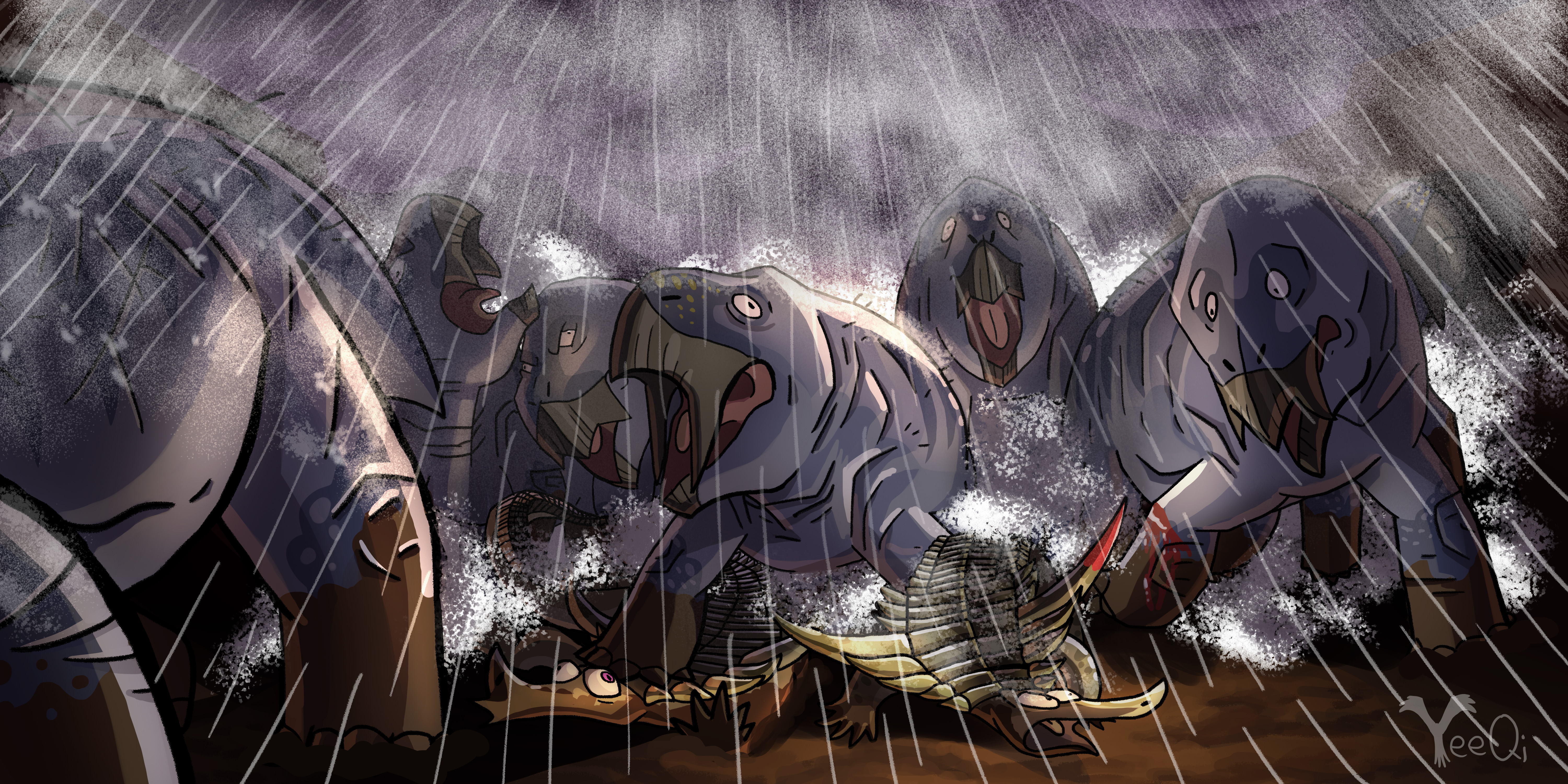
Paleoart of Placerias, one of the latest-surviving dicynodonts. Having made it straight through the Great Dying, they'd experience a rediversification during the Triassic before dying out by the Jurassic's beginning. Not only did it have actual tusks on the inside of its mouth - it also had two "false" tusks on its beak - known as maxillary caniniforms! These were sexually dimorphic - longer in males and shorter in females. They are running over a pair of juvenile Desmatosuchus, a type of aetosaur - a crocodile relative that died off after the Triassic as well. An armored back and spikes on its sides would have made for an effective defense against any predator, and it likely rooted around for plants and invertebrates in the muddy ground where it lived. Although its low profile might be effective in a predation scenario, however....this is no predation scenario.
Information