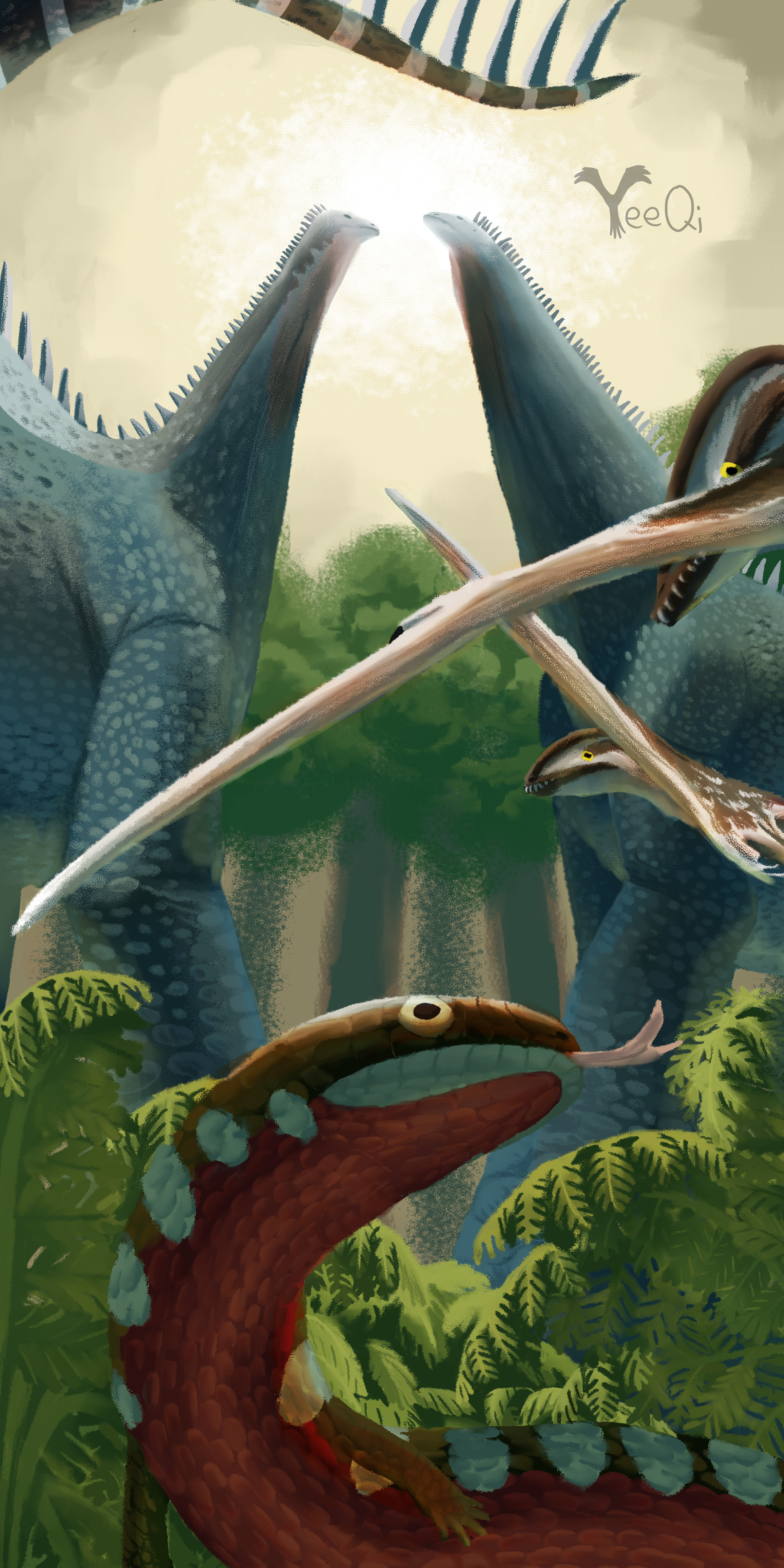
Paleoart of two Supersaurus engaging in a mating ritual. They stir up small animals from the ground like the salamander Iridotriton, and are thus followed by Harpactognathus; predatory pterosaurs. At the moment, Supersaurus is perhaps the longest known dinosaur, potentially reaching over 150 feet at maximum. One neck vertebra - BYU 9024 - hints at a monster whose neck alone was taller than a brachiosaur. Like any diplodocid, Supersaurus likely had a whiplike tail and a tiny head. The former was useful for defense, possibly - although science shows that the previous hypotheses of breaking the sound barrier would have obliterated the animal's soft tissue, this was still a tail capable of going very fast, propelled by enormous muscles! Recent research on diplodocid sauropods indicates a diverse array of scale types in a variety of shapes. The scales on these guys are inspired by the work of Tess Gallagher, who studies the skin of these types of sauropods. Diplodocus has also been found to have keratinous spikes down the back. I've chosen to give these to Supersaurus too. As some of the biggest animals of their environments, sauropods were likely ecosystem engineers, invulnerable to all but the largest of predators - maybe even stirring up insects and forcing small animals to flee in their wakes, tearing down forests, and changing the very structure of the land. For at least some sauropod species, even their *footprints* were big enough to form natural mud traps! And so, as these two sauropods meet each other - it could well be a momentous event.
Information